Believe it or not, there are sites out there that take advantage of people who want to learn online. If you're not careful, you could be a victim and lose a lot of money! Getting any education takes time, and online university programs are no different. There are no “get a degree fast” programs that are legitimate.
Providing your contact information and credit card number to a fake online learning website can cause you more than just a few problems. This opens you up to identity theft and misuse of your credit card. Your credit can become ruined for a long time and sorting out false transactions with a credit scoring agency can be a long and painful process, even if you are not at fault.
After you are robbed of good money, you still won't have an online degree. After a bad experience like this, you'll be suspicious of all online learning programs, which isn't fair to the dozens of programs that are legit.
You may even be discouraged to continue your education online, which is an unfortunate result of a bad situation. Be extremely cautious and do research for any online learning programs before sending money.
Because the market for online education is growing so rapidly, the target for online education scammers is huge. There are several different forms of fraudulence in the e-learning sector, and you should be wary of all of them.
Take Your Money and Run
Some criminals design a site that appears to be a legitimate institution. They tout the ease in which you can earn a degree in days or weeks. The fees are reasonable, which is appealing to its cost-conscious victims.
You enroll in courses and pay online with a credit card. But, you never hear from the institution. You try to contact the numbers listed, but they are disconnected. There is no education and no degree waiting for you.
Unaccredited Institutions
Unaccredited learning programs actually provide an education. It just may not amount to much. People who don't know the importance of choosing a school accredited with a reputable source like the U.S. Department of Education can fall victim to this. These programs are usually more affordable (again, that's the draw).
When a student tries to transfer credit to an accredited university, they discover that their credits are useless. Some financial aid lenders and even employers do not recognize unaccredited institutions. Your money is wasted, and you will likely have to take the same courses again at an accredited institution.
Degree Mills
Degree mills are the worst scam, and people who buy into them usually know what they are doing. Degree mills sell you a fake degree. People who buy these degrees use them to unfairly gain advantage in the workplace.
More degree mill users are getting caught, and the penalty is hefty: a fine and jail time. A real education would be cheaper and faster.
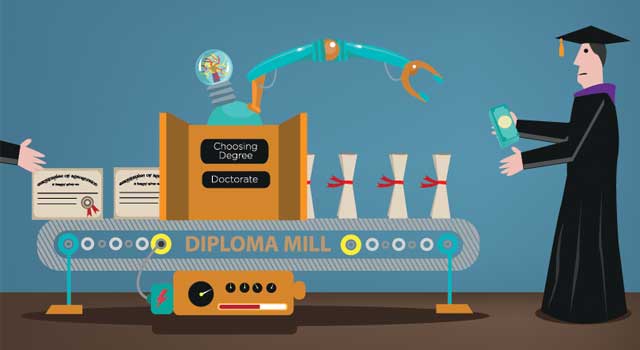
A degree mill is a fake online university that sells college diplomas rather than the education that should accompany it. Degree mills make it unbelievably cheap to "attend" Harvard or other top-tier schools. These fraudulent companies promise you a degree within 30 days, which in the real world of education, is impossible.
Some warning signs to look for when encountering a degree mill:
Do your research. If you find chat boards and forums that talk about the company negatively, stay away. You can't earn a degree without an education, so take the time to find an accredited school that will give you more than a piece of paper. Visit the Council for Higher Education Accreditation to see if a school is accredited, and if it is, you know it is a school you can trust.
While accreditation is important in searching for legitimate online learning programs, there is a gray area within the field. Some online universities claim to be accredited and they are. They are accredited by accreditation mills, which are groups with little to no educational standards that are not recognized by the U.S. Department of Education or Council for Higher Education Accreditation.
Essentially, accreditation mills will accredit any program that pays for it. That's how they get their money. So the scamming program can then honestly state on their website that they are accredited by the Underwater Basket Weavers' Agency or similarly fake organization.
Some diploma mills are branching out to offer accreditation mill services, as well, which increases the income they get by capitalizing on the unaware individual seeking to earn a degree online.
Under normal (legal) circumstances, accreditation is earned by universities and colleges based on certain requirements and standards of their curriculum and degree programs. Accreditation mills charge for the privilege to say a school is accredited.
If a school claims to be accredited, research the accrediting agency, and check with the resources you can be certain will list a school that is accredited: U.S. Department of Education or Council for Higher Education Accreditation.
If you are researching online degree programs, you will likely come across websites that offer “life experience degrees.” They claim that they can provide you a degree based on your life and work experience. Sound too good to be true? It is.
While there are some legitimate degree and certification programs that allow some credit for work experiences (project management programs, for instance), an entire degree based on your experience is a scam.
The website will likely tell you that it can get you a degree in a very short period of time -- five to 10 days. They may even offer you free verification of their services, but since they are the ones verifying themselves, this proves nothing in the way of the company's legitimacy.
The website will offer “packages” for different price tiers. The packages will include a diploma, transcripts and award of excellence, university letterhead and envelopes--essentially anything to make it look legitimate.
Keep in mind that buying one of these degrees can get you in a lot of trouble. States are mandating fines and jail time for falsifying education information and there have been several high profile cases where individuals claiming to be professionals, such as doctors, have been sued for malpractice and put in jail.
While your life and work experience is valid and important, it will not get you a degree in days.
If you are unsure if an online degree program is real or a scam, there are many trustworthy resources available online that will help you find out if a university or school is accredited or not.
U.S. Department of Education
The U.S. Department of Education's Office of Postsecondary Education has great online resources that explain what accreditation is and why it is important. It also has a detailed search function that allows you to search for accredited institutions by state or area, accrediting agency or type of degree.
Once you enter the criteria for your search, you can get more information on the school, such as its address, accrediting agency and how long it has been accredited. Be wary of schools that have only been accredited a few years (although do not necessarily rule them out; do more research). If the school has any specialized accreditation, this will also be listed.
Council for Higher Education Accreditation
CHEA also has a search function on its website to determine if a specific school is accredited. It states, however, that being listed on their site is voluntary for the institution and not all accredited schools may be listed. The site also explains degree and accreditation mills in detail.
If you do not have a specific institution in mind, you can do a general search for accredited programs. In the search results, you'll find contact information and a website for the accredited programs in the area of study you have selected.
Keep in mind that there are accreditation mills that generate accreditation for fake schools, so just because a school is listed as accredited, don't assume it's safe. Continue your research to find out if it is indeed a legitimate program.
Don't be daunted by the degree scams online. There are dozens of perfectly legitimate programs that will let you work toward a degree. Just do your homework in advance and you'll find a program that is right for you!
If you fall victim to an online degree rip-off, you will likely never get your money or time back. But you can do certain things to make sure others don't fall into the same trap.
Report the Fraud
There are several resources you have that let you report Internet fraud. The Internet Fraud Complaint Center, a partnership between the FBI and the National White Collar Crime Center, allows you to report fraud and view tips and warnings about specific sites.
Tell the World
You can take advantage of the many online forums and chat rooms out there to warn others about the site that cheated you. By telling your story, you may prevent someone else from making the same mistake you did.
Start a Blog
Depending on how vindictive you feel toward your run-in with a criminal, you might even write a blog about your experience. You can start with the fake university or program you were swindled by, and add other programs that you find out are scams, too.
You can easily build an online community of people who are interested in learning more about new scams. You could even send out an e-newsletter to subscribers that includes alerts on the latest online degree con.